 EN
 AR
 FR
 PT
 RU
 ES
 BG
 HR
 CS
 DA
 NL
 FI
 DE
 EL
 HI
 IT
 JA
 KO
 NO
 PL
 RO
 SV
 CA
 TL
 ID
 SR
 SK
 UK
 VI
 HU
 TH
 TR
 MS
 AZ
 KA
 BN
 LO
 MN
 MY
 UZ


 EN
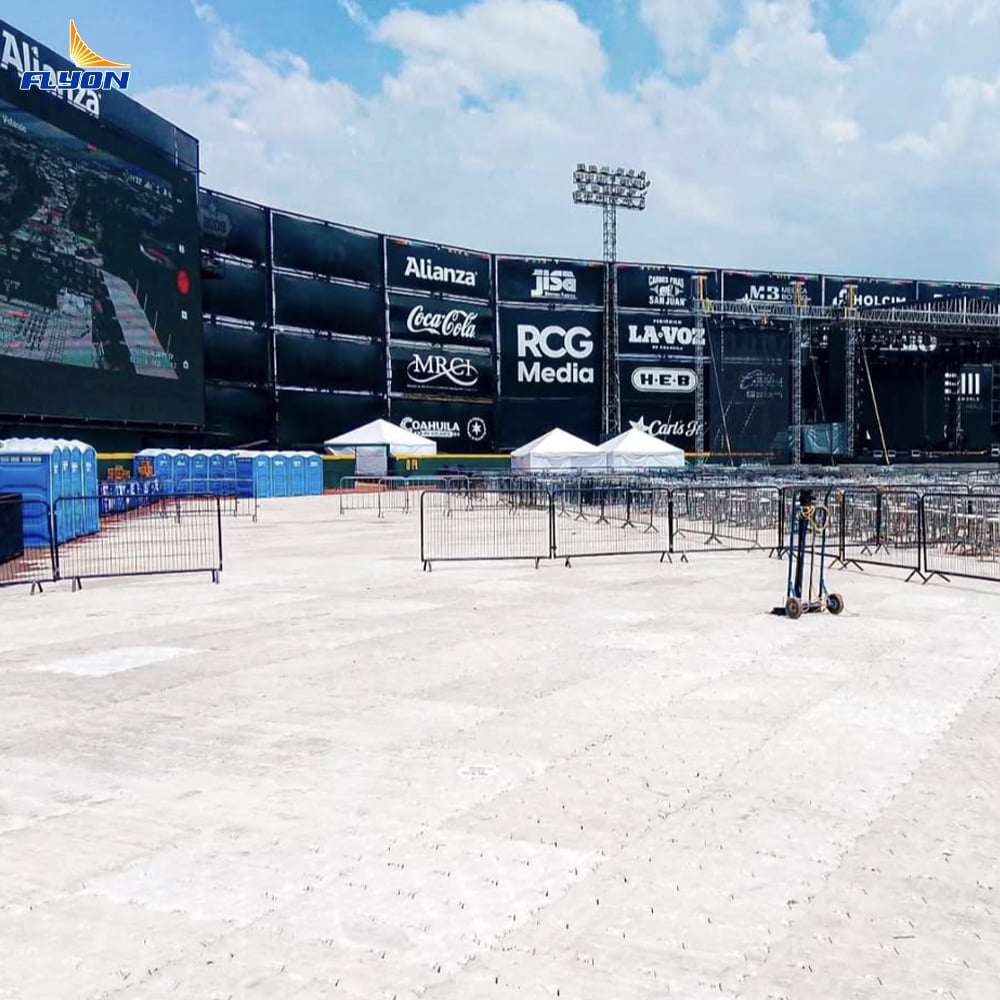
Why Composite Mats Are Essential for Turf Protection in Sports Venues
How Load Distribution Prevents Surface Damage on Natural and Synthetic Turf
Composite mats protect turf by distributing concentrated wheel, outrigger, and foot loads across a significantly larger surface area—critical during high-traffic load-in and load-out operations. Forklifts, scissor lifts, and staging carts repeatedly traverse the same paths, exerting pressures far beyond what turf can safely absorb. Healthy natural turf begins to compact at just 7–10 psi, while a loaded utility vehicle may apply 35–80 psi at the tire contact patch (Sports Turf Managers Association, 2026). Without mitigation, this pressure compresses soil particles, restricting air and water movement, suffocating roots, and creating persistent ruts. Synthetic turf faces parallel risks: heavy point loads crush fibers, displace infill, and strain seam welds. High-density polyethylene (HDPE) composite mats—with engineered tread patterns and interlocking edges—form a rigid, continuous load path that keeps surface pressure below damage thresholds. They eliminate direct tire-to-root or tire-to-infill contact, reduce shear forces during vehicle turns, and preserve consistent field conditions. As a result, event crews operate confidently on either surface without triggering the deep compaction that drives costly post-event restoration.
Proven Performance at Elite Events: UEFA Champions League and NCAA Championships
Elite venues rely on modular composite mats to safeguard premium turf under extreme operational demands. During UEFA Champions League match weeks, these systems support stage infrastructure, broadcast equipment, and maintenance vehicles on hybrid pitches—without requiring sod replacement afterward. Similarly, NCAA championship venues deploy HDPE ground protection mats for load-in, halftime staging, and camera platforms, maintaining field integrity across consecutive competitions. A 2026 venue operations review found protected turf areas recovered 60% faster than unprotected zones. Venue managers report fewer turf failures and lower annual maintenance costs after adopting interlocking ground protection systems. UEFA pitch consultants and NCAA field supervisors cite modular composites as essential for retaining pitch certification between high-profile events. By minimizing compaction and seam stress, they enable back-to-back event hosting without compromising player safety or broadcast quality—making them a proven, trusted solution for elite sport.
Composite Mat Applications Beyond Sports: Temporary Surfaces for High-Traffic Events
Rapid Deployment on Sensitive Subgrades (Grass, Soil, Paving)
Modular composite mats offer event managers a fast, repeatable method to establish stable work zones on grass, loose soil, and finished paving—without excavation, grading, or gravel bases. Lightweight enough for two-person installation and designed with direct interlocking edges, they minimize disruption to sensitive turf or landscaped areas. The high-friction top surface reduces slip hazards when moving carts, generators, or temporary fencing over uneven terrain. In wet conditions, the mats bridge soft spots and prevent rutting from repeated foot traffic. For scheduled events, this speed shortens setup and teardown windows; for protected sites, it eliminates the need for expensive regrading or turf repair after a single weekend.
Heavy-Duty Flooring Solutions for Festivals, Weddings, and Construction Access
Festivals, weddings, and construction staging share a core challenge: supporting heavy loads without lasting surface damage. Modular composite panels deliver a clean, stable, load-bearing floor ideal for pedestrian flow, service vehicles, and material handling. At large outdoor festivals, crews lay mats at entry gates, vendor rows, and generator pads to maintain safe access after rain. Wedding planners use slim, low-profile sections to create accessible walkways and dance floor foundations on soft grass. Construction teams deploy the same panels for temporary access roads and staging—particularly where underlying surfaces are preserved or under restoration. Resistant to moisture, rot, and chemical exposure, composite mats can be cleaned, stacked, and reused season after season. This reusability cuts waste and per-event flooring costs compared with single-use plywood or plastic roll-out systems.
Material Science Behind High-Performance Composite Mats
HDPE Core, UV Stabilization, and All-Weather Structural Integrity
High-Density Polyethylene (HDPE) forms the structural backbone of high-performance composite mats—delivering a service life of 10–20 years, far exceeding laminated wood alternatives (industry durability data, 2025). HDPE’s near-zero water absorption ensures dimensional stability and consistent weight in all weather, while integrated UV stabilizers and mineral additives guard against solar degradation. Because the material is impermeable, mats neither absorb rainwater nor transfer soil, seeds, spores, fungi, or chemicals between sites—reducing cross-contamination risk and ensuring even load distribution under heavy equipment. The rigid core spreads point loads uniformly, further mitigating rut formation. This all-weather resilience enables reliable turf protection across hot, cold, and rainy event cycles.
Sustainability Features: Recycled Content, Reusability, and Environmental Compliance
Many HDPE-based composite mats incorporate post-industrial or post-consumer recycled content—reducing dependence on virgin polymers without sacrificing structural performance. Their 10–20-year lifespan supports repeated deployment across sports, festivals, and construction projects, dramatically lowering per-event material consumption. Impermeability aids environmental compliance by preventing ground contamination and limiting the spread of invasive species or chemical residues. Lighter weight reduces fuel use per transport trip, and resistance to moisture and biological decay means mats can be cleaned, stored, and redeployed without chemical treatments. Together, recycled input, long-term reusability, and pollution control make composite mats a practical, responsible choice for environmentally sensitive venues.
Design Intelligence: Modular Interlocking and Scalable Installation
A well-engineered composite mat system uses precision interlocking edges to form a continuous, stable surface—no bolts, anchors, or adhesives required. Each panel transfers load laterally to adjacent units, eliminating pressure concentration and preventing gaps under live traffic. This modular design allows seamless scaling—from narrow walkways to full stadium coverage—in stages aligned with evolving venue layouts. Panels can be cut or arranged to follow curved track edges, goalmouths, or stage ramps while maintaining edge integrity and load-bearing continuity. Because installation and removal are tool-free and fully reversible, labor requirements drop significantly versus bonded or anchored systems. Event teams can pre-stage partial coverage and expand as crowd flow or weather dictates. Interlocking also minimizes tripping hazards at seams—a key safety advantage for mixed pedestrian and equipment traffic. The result is a highly adaptable temporary floor that integrates with permanent infrastructure—preserving the underlying surface while supporting everything from compact training zones to large-scale championships with minimal operational downtime.
FAQ
Why are composite mats necessary for sports turf protection?
Composite mats are essential for sports turf protection because they distribute heavy loads like vehicles and equipment, preventing surface damage such as soil compaction and crushed turf fibers.
What are composite mats made of?
Composite mats are typically made of High-Density Polyethylene (HDPE), which offers durability, water resistance, and UV stability for long-term use.
Can composite mats be reused?
Yes, composite mats are reusable and designed for a service life of 10–20 years, making them a cost-effective and environmentally friendly option for repeated events.
What are the benefits of using composite mats at large events?
Composite mats provide a stable, non-slip surface for heavy loads, reduce setup times, prevent surface damage, and can be quickly deployed and removed without causing disruption.
Are composite mats eco-friendly?
Yes, many composite mats include recycled materials, reduce material wastage through reusability, and are resistant to contaminants, making them environmentally sustainable.
What types of events benefit from composite mats?
Composite mats are ideal for sports venues, festivals, weddings, construction sites, and any high-traffic events requiring surface protection or temporary flooring solutions.