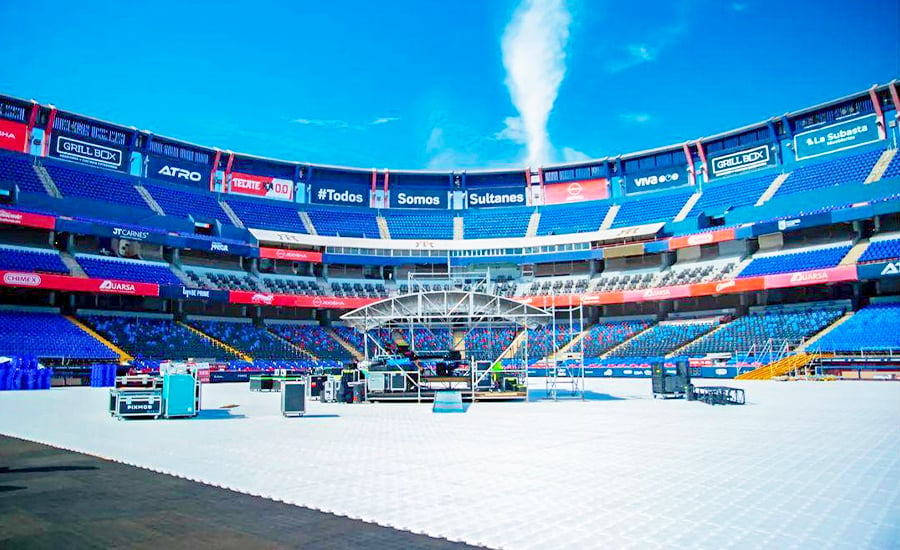
Portable outdoor flooring has been designed to handle whatever Mother Nature throws at it. The best quality options can get rid of almost all rainwater from their textured surfaces in just about half a minute. Meanwhile, those clever interlocking joints keep things stable even when winds hit around 50 miles per hour, losing only a small fraction of their strength. Traditional materials like wood or concrete just can't compete with this kind of performance. Anyone who's dealt with soggy wooden decks knows how quickly water pools and creates problems. Concrete might seem sturdy but shifts over time when stressed by weather extremes. These modern flooring solutions simply stand up better to harsh conditions without breaking down.
When it comes to fighting against strong winds, manufacturers have turned to some clever solutions like cross linked polymer materials and special shapes that cut down on wind lift by around 34% when compared with regular flat surfaces. Products also feature ribbed bottom sections and heavier edges which really helps them stay put during those intense gusts. We're talking about being able to handle steady winds of up to 75 miles per hour, something that matters a lot for properties located along coastlines where hurricanes are common. The combination of these engineering tweaks means equipment can keep working properly even when Mother Nature throws her worst at it.
A popular beachfront resort in South Beach had their concrete deck washed away multiple times during hurricanes before finally switching to these durable plastic tile systems. When Hurricane Season rolled around again in 2023, something remarkable happened. The new floor held up against massive floods reaching nearly four feet deep and wind speeds that topped 68 miles per hour. Nobody expected it to survive those conditions honestly. The owners calculated they probably saved around $180k on repairs alone, but there was another benefit too. They got back open for business just three days after the storms passed, while most nearby hotels were still picking up debris weeks later. Some neighbors actually came over asking where they bought their tiles from!
Contractors report a 240% increase in commercial orders for storm-rated portable flooring since 2021, driven by insurance requirements in high-risk zones. According to Global Market Insights (2024), the global market for climate-adaptive outdoor materials will reach $9.2 billion by 2028, with modular flooring capturing 38% of new hospitality and municipal projects.
Today's portable flooring options typically use around four main material types, each designed for different settings. Composite decking can handle about two and a half times the pressure compared to regular wood, which makes it great for long term outdoor projects. The interlocking plastic tiles we see so much these days drain water really well too, with tests showing they let water escape at nearly 98% efficiency during heavy rain conditions. Rubber pavers are another good choice, especially where people walk a lot since they absorb impacts about 40% better than standard concrete surfaces. And don't forget artificial grass either, many newer varieties come with special coatings that fight off mold growth even when installed in places prone to moisture buildup.
Advanced recycled rubber formulations deliver a static coefficient of friction of 0.75—exceeding ADA standards for wet surfaces. Field data shows a 62% reduction in slip incidents compared to composite alternatives during rain. The material’s natural elasticity allows less than 2mm deflection under 250 lb loads, balancing cushioning with structural resilience.
HALS (Hindered Amine Light Stabilizers) technology reduces color fading by 87% over five years of outdoor exposure. Accelerated testing confirms only 12% Î color change after 3,000 hours of UV exposure—a threefold improvement over 2018 benchmarks. Interlocking mechanisms remain precise, maintaining sub-0.5mm gap tolerances through repeated thermal expansion cycles.
Independent analysis of 1,200 installations reveals a 23% gap between advertised and actual lifespan. While 87% of products meet 5-year durability claims, only 54% achieve their stated 10-year benchmarks. Stress tests show polyethylene tiles retain 91% load capacity after 15 freeze-thaw cycles, significantly outperforming PVC, which retains just 67%.
Smooth portable flooring increases slip risk by 58% during heavy rain, according to industrial safety data. Water reduces surface friction, especially when combined with wind-driven precipitation and organic debris like algae or leaves, creating dangerous conditions in outdoor spaces.
Engineered textures such as crosshatch and diamond-plate patterns boost wet slip resistance to a Pendulum Test Value (PTV) of 50+, well above safety thresholds. These multi-point contact designs maintain grip even when partially submerged. Studies confirm they reduce fall incidents by 72% compared to smooth surfaces in simulated storm conditions.
A Colorado mountain resort replaced slick flagstone with ridged rubber pavers, resulting in zero weather-related injuries over two rainy seasons. The ¾” deep treads provided directional traction for hikers, while ¼” gaps between units prevented water accumulation. Resort management noted 89% guest satisfaction with the flooring’s balance of safety and aesthetics.
| Design Feature | Water Evacuation Rate |
|---|---|
| Basic Flat Tiles | 12 gal/min per m² |
| Channeled Tiles | 37 gal/min per m² |
| Sloped Systems | 52 gal/min per m² |
Angled interlocking tiles with integrated runoff channels evacuate water four times faster than conventional flat designs. This rapid drainage mitigates hydroplaning risks and preserves stability during intense downpours.
Today’s manufacturers blend safety features with realistic woodgrain and stone-look finishes. A 2024 consumer survey found 68% prioritize “discreet safety features,” driving innovation in UV-stable traction coatings that mimic natural textures without compromising performance.
More and more people who own homes or plan events are going for modular systems these days because they work well with changing seasons and tricky ground conditions. According to research from Grand View in 2023, around two thirds of customers want to install things themselves now. That's actually up nearly a quarter compared to what we saw back in 2020. This reflects something bigger happening across the industry where folks are looking for adaptable yet professional quality options outdoors. The latest improvements make life easier too. Manufacturers have started including pre cut edges and using different colors for connectors which cuts down on mistakes during assembly by roughly 40 percent according to the Outdoor Flooring Innovations Report released last year.
Patented snap-lock mechanisms secure panels in 3–5 seconds per joint, as verified in third-party stress tests. Unlike rigid decking, these tiles accommodate up to 0.5" ground variation while maintaining a seamless surface—ideal for pool decks and campsites.
| Feature | Traditional Decking | Modern Interlocking Tiles |
|---|---|---|
| Installation Time | 8-12 hours | 45-90 minutes |
| Weight per sq.ft | 4.2 lbs | 1.8 lbs |
| Max Slope | 0.1" | 0.5" |
| Data sourced from 2024 Material Efficiency Benchmarks |
In a coastal metropolis, a 1,200 sq.ft rooftop was retrofitted with UV-stabilized plastic tiles weighing 2.1 lbs/sq.ft—38% lighter than composite options. No structural reinforcements were needed, and the floor survived 55 mph winds in its first year with no warping or drainage issues.
Key engineering strategies include:
These features, highlighted in the Ultimate Guide to Portable Event Flooring, reduce maintenance costs by 60% compared to permanent installations, making them ideal for rental services and seasonal venues.
What makes outdoor portable flooring ideal for heavy rain and strong winds?
Outdoor portable flooring is designed with interlocking joints and textured surfaces that efficiently drain water and maintain stability even during winds up to 50 mph.
How do manufacturers enhance the weather resistance of portable flooring?
Manufacturers use cross-linked polymer materials and special shapes to reduce wind lift and maintain stability during intense gusts.
What materials are commonly used in outdoor portable flooring?
Common materials include composite decking, plastic tiles, rubber pavers, and artificial grass, each offering unique benefits in terms of durability and safety.
How do textured surfaces improve safety in wet conditions?
Textured surfaces like crosshatch and diamond patterns significantly improve traction, reducing slip incidents by 72% compared to smooth surfaces during rainy conditions.
Are there any benefits to using rubber pavers?
Rubber pavers provide excellent slip resistance and impact absorption, making them a safe and flexible option for outdoor flooring.
Why is there growing demand for modular, DIY-friendly outdoor flooring systems?
Due to ease of installation and adaptability to varying ground conditions, more consumers prefer DIY modular systems that can be installed without professional assistance.
 Hot News
2026-09-30
2026-08-24
2026-08-10
2026-07-13
2026-07-10
2026-06-08
 EN
EN
 AR
AR
 FR
FR
 PT
PT
 RU
RU
 ES
ES
 BG
BG
 HR
HR
 CS
CS
 DA
DA
 NL
NL
 FI
FI
 DE
DE
 EL
EL
 HI
HI
 IT
IT
 JA
JA
 KO
KO
 NO
NO
 PL
PL
 RO
RO
 SV
SV
 CA
CA
 TL
TL
 ID
ID
 SR
SR
 SK
SK
 UK
UK
 VI
VI
 HU
HU
 TH
TH
 TR
TR
 MS
MS
 AZ
AZ
 KA
KA
 BN
BN
 LO
LO
 MN
MN
 MY
MY
 UZ
UZ


 EN
EN